Sunday afternoon. Your kitchen table is covered in laptop, a mug of coffee that's gone cold, and a notebook with a list of animals whose Petfinder listings need updating. Three got adopted last week and are still showing as available. Two new intakes don't have listings yet. One needs updated photos because the original intake shot had the transport carrier in the background. The process of fixing all this will take about two and a half hours. You're doing this instead of finishing a book, taking a walk, or basically anything else a human might do on a Sunday.
That's the Petfinder management treadmill. The data already exists somewhere. It's just a matter of copying it into Petfinder's format, one pet at a time. For a rescue with 10 animals it's annoying. For a rescue with 50 it's a part-time job. When listings inevitably go stale because life happens, adopters see outdated info and the rescue looks disorganized.
Automatic sync takes most of that work off your plate. You manage pets in one system, and Petfinder updates itself from there.
How Petfinder sync works
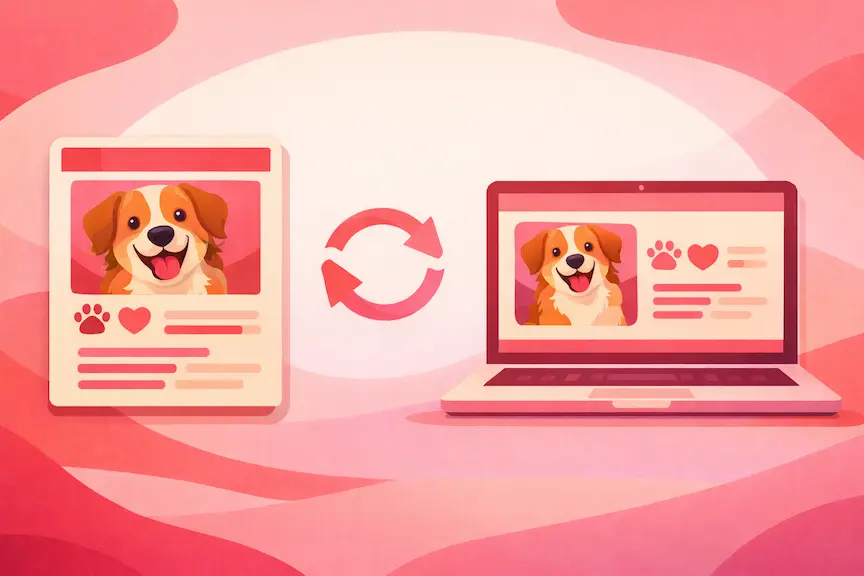
The basic idea is simple. Pets are managed in the rescue's software: names, photos, bios, status, breed, age, all of it. When something changes, PawPlacer includes that pet in the next Petfinder CSV export and uploads it to Petfinder's FTP import. Nobody has to retype the listing in Petfinder. The internal system stays up to date and the listings take care of themselves after Petfinder processes the import.
A pet's status changes from "available" to "adopted," and the next export sends the updated Petfinder status. New photos uploaded to a pet's profile show up on Petfinder after Petfinder fetches the public image URLs. Updated the bio because the dog is actually great with cats? The Petfinder listing reflects it after processing.
Sync can be run manually from PawPlacer, and active integrations are also picked up by the scheduled sync. Petfinder processes imported files on its own schedule, so changes are not instant on Petfinder.com.
What's needed before starting
A Petfinder account with FTP import access for PawPlacer. Existing Petfinder website or API credentials do not work for this integration. PawPlacer includes an email draft you can send to Petfinder to request the FTP username and password for your organization.
Complete pet profiles. Sync can only push data that exists. Profiles missing photos, bios, breed info, or age produce incomplete Petfinder listings. Setting up sync ends up being a nice forcing function, too. It's a great reason to finally clean up the profiles.
A management tool that supports Petfinder's import workflow. PawPlacer has this built in, and some other platforms do too. Spreadsheet users are stuck with manual updates unless they build a custom integration, which isn't worth it for most rescues. Better to switch to a tool that handles it.
What setup looks like
Details vary by platform, but the general flow is the same. Request Petfinder FTP access, save the FTP username and password in PawPlacer, review the generated CSV preview, fix validation issues, and sync the file to Petfinder.
The first sync is the one worth paying attention to. Review those initial listings to make sure photos are in the right order, bios look correct, and breed mappings make sense. After that, it's hands-off.
Things people get wrong
Stale photos. Sync pushes whatever photos are on the profile. One blurry intake photo uploaded three weeks ago and never replaced is what Petfinder shows. Keep photos current. It's the single biggest factor in whether someone clicks on a listing.
Incomplete bios. "Sweet dog needs home" is technically a bio. It's also going to get scrolled right past. The more specific the bio (personality, energy level, what they're like in the house, who they're good with), the better the listing performs. Write the bio in the management system and let it push through.
Status confusion. Changing a pet's status to "adopted" in PawPlacer but forgetting that the Petfinder listing was manually created outside the sync produces ghost listings that sync can't control. Once sync is turned on, let it manage all Petfinder listings. Don't mix manual and automatic.
Breed and age mismatches. Petfinder has its own breed taxonomy. A pet listed as "Pittie Mix" in the rescue's system won't match if Petfinder's breed list doesn't have that exact term. Most management tools handle this with breed mapping, but spot-check the first few synced listings.
Beyond Petfinder
Petfinder is the biggest adoption site, but it's not the only one. Adopt-a-Pet, RescueMe, and various regional sites also accept listings. PawPlacer includes built-in listing sync for Petfinder and Adopt-a-Pet. RescueGroups.org and other listing channels are separate workflows today.
The more places the animals are visible, the faster they find homes. Just be clear about which channels are automated and which ones still need a manual or separate integration process.
The time you get back
For a rescue with 30 available animals, manual Petfinder management is easily 3-5 hours a week. Update listings, add new animals, remove adopted ones, upload photos, fix typos in bios. That's 150-250 hours a year spent being a data entry clerk.
With sync on, that drops to essentially zero ongoing time. A few minutes of setup, then the rescue just manages pets in its own system (which was happening anyway) and Petfinder stays current automatically.
Those hours go back to the animals. More time for foster coordination, adoption follow-ups, medical care, community engagement. The stuff that actually gets animals into homes, instead of copying and pasting bios between two browser tabs on a Sunday afternoon.